
Jed Michael, Global Affairs Officer
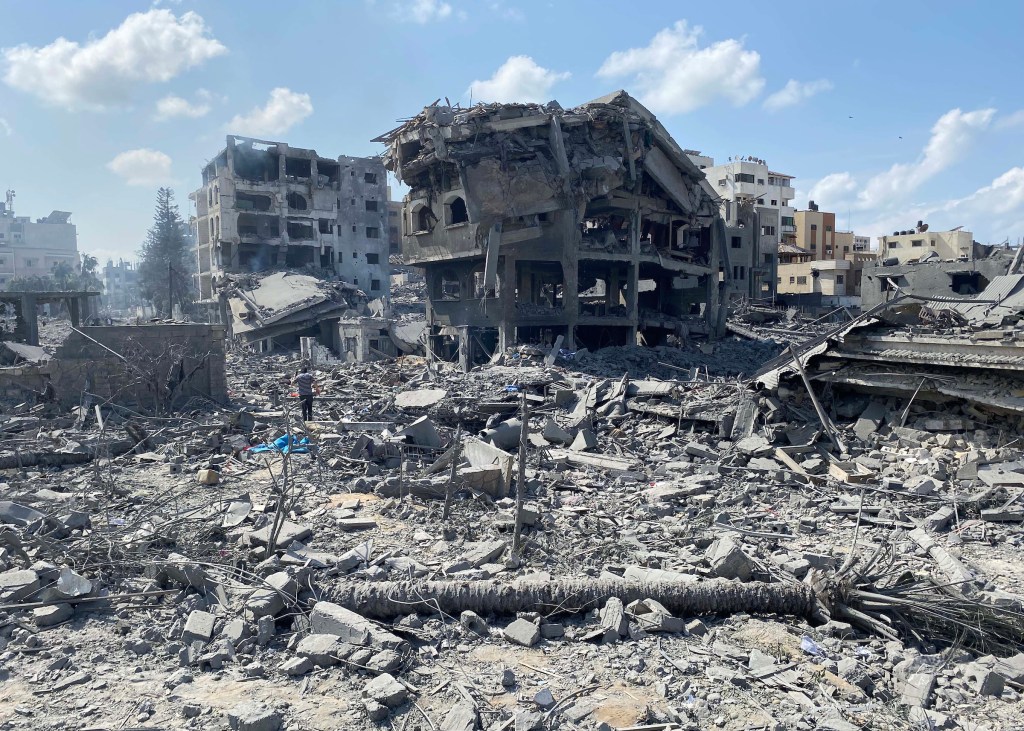
Creator: Naaman Omar, Copyright: Creative Commons
Even before the Israeli tightening of the blockade of Gaza following the violent HAMAS incursion of October 7th, which has left the enclave without power and crucial humanitarian resources, the situation was dire. Data from 2022 suggests that over half the population require food assistance, 78% of the piped water is unfit for human consumption, and unemployment is at a staggering 46.6%, with it being even higher for young people. Taking a wider view of development as advocated by Sen highlights further problems – the blockade drastically limits freedom of movement, often including in cases of medical emergency, and residents often live in constant fear of both local and Israeli authorities.
To be clear, this is not entirely Israel’s fault, although their role in creating unnecessarily torrid conditions undoubtedly deserves greater scrutiny. HAMAS, the ruling authorities in Gaza, must also shoulder much blame. Residents of Gaza have reported them stealing from citizens to fund violent resistance against Israel. Additionally, reasonable evidence suggests they have at least sporadically used civilians as human shields (deliberately firing rockets from residential areas or near educational / health facilities in an attempt to increase the civilian cost of retaliation), and have generally done a poor job at administering the territory. A friend who has recently returned from volunteering in a Greek modally-Palestinian refugee camp has recounted many such stories – particularly regarding HAMAS treating Gazans horrifically – and observed that Palestinians hated HAMAS sometimes even more than Israel.
The implication of this is a pressing, but vexing question of development. How can we support development in persistent conflict zones such as the Gaza Strip? Particularly in light of recent HAMAS violence, Israel is (understandably) reluctant to countenance the provision of development aid and funds that have the potential to be expropriated for violent purposes. Given the regularity of HAMAS stealing from its citizens, Israel claims that most varieties of humanitarian support may result in supporting violent HAMAS activities. Additionally, direct investments in infrastructure – roads, schools, hospitals – are often eradicated by sporadic Israeli bombing raids or even HAMAS rockets falling short of the border. Such conditions inhibit the currently in-vogue strategy of incremental development as advocated by Banerjee and Duflo that has proved successful under more benign conditions.
The obvious answer to this development problem is that the conflict needs to be resolved for development to be viable. Clearly, development in Gaza cannot be separated from the context of the wider Israeli-Palestinian conflict. And yet, analysing Palestinian economic fortunes independently from their political predicament has been at the centre of many international attempts to reduce violence and improve economic conditions in Palestine. In particular, the most recent attempt – the Trump ‘Peace to Prosperity’ plan – essentially revolves around the idea that some more international investment alongside a couple of business zones will resolve the conflict and thus facilitate development, even though it leaves the Palestinians with only what can generously be described as a quasi-state. Instead, long-term development in Gaza requires international community willingness to pursue genuine peace through reconsideration of unconditional support for Israel. This should involve less of a sacrifice for Western actors than is often portrayed, I would suggest current levels of support for Israel lack a compelling moral or strategic case.
Often, such a position is falsely equated with support for HAMAS – untenable in light of recent violence. However, this is not the case. It merely requires acknowledging that Palestinian grievances deserve at least equal attention to Israeli security concerns. From here, a number of entirely non-radical policy options can be placed on the table. These include making aid for Israel contingent on reasonable treatment of the Palestinian people as defined under international law, considering Israeli violence against civilians as categorically similar to Palestinian violence against civilians, and approaching peace negotiations in a more even-handed manner than in the past.
This variety of conceptual and policy-oriented understandings of the conflict are unfortunately quite a long way away from being realised in the international community. However, they are essential in order to begin the process of meaningful development for innocents in Gaza. Otherwise, those in Gaza will be left with a ‘one-step forward, two-steps back’ development trajectory that has already left many citizens with the view that a refugee camp in Greece is a better alternative. This is not an acceptable outcome.
These lessons can be effectively applied to conflict zones more widely – in essence the takeaway, contra neoclassical economics, is merely that political injustices can rarely be solved through economic policy. In Gaza and elsewhere, the international community should stop acting otherwise.
If you want to think more about development in conflict contexts, then ‘The Security-Development Nexus’, edited by Amer, Swain and Öjendal, is a good place to start. I would also highly recommend ‘The Israel Lobby and U.S. Foreign Policy’ by Mearsheimer and Walt as an eloquent and moderate account of why unconditional support for Israel lacks compelling moral or strategic rationale.

 Oxford Society for International Development