
EMILY DANIEL
Over the past decade, India has experienced a remarkable surge in economic growth under the leadership of Prime Minister Narendra Modi and his Bharatiya Janata Party (BJP). His tenure has been marked by ambitious economic reforms and infrastructure development initiatives, positioning India as one of the world’s fastest-growing major economies. However, this economic progress has been accompanied by growing concerns about widening inequalities and signs of democratic erosion, under Modi’s leadership.
Inheriting an economy teetering on the edge of stagnation in 2014, Modi faced the task of reviving India’s economic engine. A decade later, India’s trajectory appears, on the surface, nothing short of remarkable. Outpacing major economies, its banks are strong, and government finances have stayed stable, even throughout the pandemic. The most notable improvements to India’s economy, led by Modi, have stemmed from infrastructure improvement, which has led to the building boom of railways, ports, bridges, roads, and airports. Upgraded transportation networks can improve efficiency of businesses (reducing costs), attract more domestic and foreign investment, and boost productivity in various sectors. These contributions have allowed India to surpass the UK to claim the fifth-largest economy spot, underscoring its resurgence. Forecasts by analysts at Morgan Stanley paint a picture of further ascension, poised to eclipse Japan and Germany, eyeing the third spot by 2027.
However, beneath the veneer of progress lies a stark reality. For many, life on the fringes of subsistence persists. Despite the headline-grabbing growth figures, the labour force’s participation rate stagnates and real wages show minimal improvement since 2014. While India may have the fifth largest GDP, it languishes far behind on a per capita basis, occupying the 140th position. This tale of two Indias underscores the complexity of its growth narrative, urging a deeper examination beyond surface-level successes.
While the country was estimated to have halved the share of population living in extreme poverty, recent years have seen a deceleration in this trend, indicating persistent structural barriers. The low participation of women and young people in the labour force not only exacerbates gender and age disparities but also hampers overall economic potential. These employment issues are mainly the result of private sector growth, particularly in manufacturing and services, which has not kept pace with the shift from agriculture, leaving many job seekers stranded. While the private sector is expected to absorb these workers, the growth in these sectors hasn’t been fast enough to create sufficient jobs for the people leaving agriculture. Alarmingly, female employment rates are among the lowest globally at less than 40%, and youth unemployment reached a staggering 45.4% in 2023, according to the Centre for Monitoring the Indian Economy. This has become a focal point of political discourse, as Modi’s opponents positioned joblessness as a central campaign issue in the lead up to the recent election. While Modi’s government claims to have implemented measures to address job creation, the persistence of these inequalities underscores the difficulty of formulating and executing effective policies in India.
Initially, as prime minister, Modi promised a transformative agenda centred on inclusive economic development for all citizens, aiming to shed his past image. His recent actions and rhetoric suggest a different trajectory. This may not come as a surprise given his past, as the state of Gujarat’s chief minister in 2002, when more than 800 Muslims were killed under his watch. A British government report directly implicated Modi in failing to prevent violence against Muslims, despite his repeated denials and subsequent clearance by the Supreme Court. While campaigning for the recent election, Modi made a speech in which he claimed that the previous prime minister, Manmohan Singh, had declared that Muslims had ‘the first claim’ to the nation’s resources. This statement was referring to a speech delivered by Singh in 2006 concerning India’s development priorities, although it had been distorted from the original speech, which was suggesting that marginalised communities should be “empowered to share equitably the fruits of development”. By violating election conduct norms in his speeches, Modi appears to be attempting to exploit the fears of his core voter base. This not only seems to contradict the ‘inclusive’ development promised to all citizens, but also points to deeper issues in India’s ‘democratic’ processes.
Under Modi’s leadership India has witnessed a concerning erosion of democratic principles, sparking debates and concerns both domestically and internationally. The economist democracy index rates the country as a ‘flawed democracy’, highlighting in their report that, despite achieving economic growth, Modi’s government has “taken advantage of strong public support to restrict media freedoms or minority rights”. Further evidence of democratic decline can be found in instances of electoral irregularities, such as in a constituency in Modi’s home state, where his candidate was declared elected unopposed due to the major opposition party, Congress, having their candidate rejected for ‘discrepancies in paperwork’. Although unclear, the party suspects the possibility of misconduct, and the situation has raised questions about the integrity of the democratic progress. Additionally, concerns were raised, as the election neared, as “parties and leaders were raided by government agencies; two chief ministers…were jailed; and bank accounts belonging to Congress were frozen by the income-tax authorities.” The opposition parties, at this point before the election, appeared to stand little chance against Modi’s dominant political narrative.
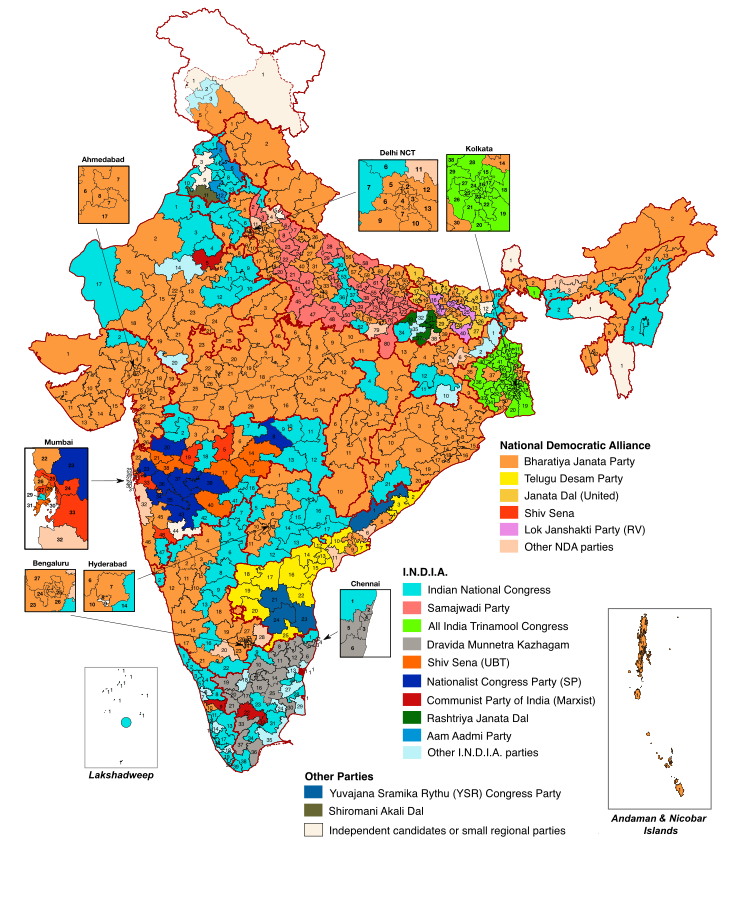
Although Modi ultimately secured victory, the election proved to be a partial success for the opposition parties. Despite their initial struggles, they managed to gain significant ground, preventing Modi’s party from achieving an overwhelming majority. Modi was, instead, forced to accept a coalition government, where the opposition parties have secured a stronger voice in shaping policies. While they couldn’t fully unseat Modi, their ability to force a coalition demonstrates a growing challenge to his dominance.
What is clear now, is that India’s government is facing mounting scrutiny over the erosion of democratic norms and principles under Modi’s tenure, despite identifying as the world’s largest democracy. While the country has made remarkable strides in bolstering its economy, these gains are tempered by persistent inequalities and democratic challenges. As India navigates its path forward, addressing these intertwined challenges will be essential to ensure that economic prosperity is truly inclusive and sustainable, and that the principles of democracy and social justice remain at the forefront of the nation’s development agenda.
SHARE THIS ARTICLE:


